
Free Building Product Specification Templates
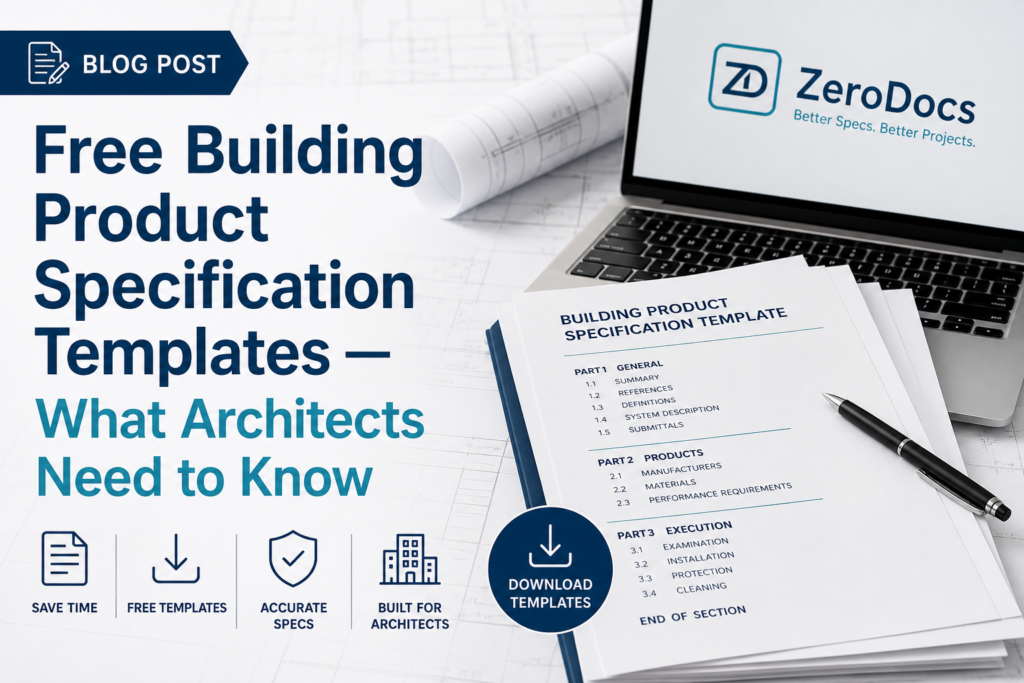
Free Building Product Specification Templates — What Architects Need to Know
If you’ve ever searched for a free building product specification templates at 10 pm before a deadline, you already know the problem.
You find something. You open it. And then you spend the next two hours rewriting it before it’s actually usable on your project.
Free isn’t always free. Sometimes free costs you time you don’t have.
What Makes a Building Product Specification Template Actually Useful
Not all specification templates are created equal. The difference between a template that saves you time and one that creates more work comes down to four things.
It has to be editable. A template you can’t customize for your project isn’t a template; it’s a starting point you have to rebuild from scratch. Every good specification template should open directly in Microsoft Word, with clear [bracketed] placeholders that tell you exactly what to change and where.
A 3-part specification has a specific structure —> General, Products, Execution. Each part serves a different function in the construction process. A template that gets this wrong creates problems downstream; in the contract documents, in the field, and in conversations with contractors looking for ambiguity they can use.
It has to be concise. The best specification templates are one to four pages, depending on the product and project. A template that runs 10 or 15 pages signals that the author has loaded many requirements that architectural projects don’t always need. Architects don’t have time to edit a document that long. They move on to the next one.
There’s a difference between a template assembled from existing language and one written by a working specifier who has sat across from architects, reviewed submittals, and watched specifications hold up or fall apart in the field. Experience that transfers into how a template gets written.
The Problem With Most Free Specification Templates
Free specification templates are widely available from building product manufacturers. The goal is to have their product specified based on design.
Their intent is to document a single manufacturer’s product or system, not to document how to widely specify a specific product segment. They often use marketing language where technical language belongs. They include performance criteria that favor one manufacturer over all others. They’re proprietary
An architect who pulls a manufacturer’s free spec template into their project manual and doesn’t edit it carefully is taking on liability they may not realize they’re accepting.
The best free specification templates are those written with the architect in mind. Neutral in tone, technically accurate, well-structured, and easy to customize for the project at hand. Or makes coping and pasting information into an existing specification structure much easier.
When Free Works and When It Doesn’t
Free specification templates work well when the goal is straightforward —> you know the product, you know the requirement, and the spec is largely a formality.
They become a time problem when the project is more complex. Multiple products. Differing performance criteria. Any ambiguity seen in the field might be seen as an RFI or an opening to discuss the specifications requirements.
That’s when the math changes.
Free stops being free the moment you factor in the hours spent researching alternatives, editing language that wasn’t written for your project, and tracking down products that meet the same performance requirements. That time always exceeds the cost of starting with a professionally written template built for real projects from the beginning.
Not because free is bad. Because getting it right the first time is always cheaper than fixing it later.
What SpecsMadeSimple Offers
SpecsMadeSimple offers professionally written 3-part specification templates for architects. Built for real projects, written by a specifier with 30+ years in commercial specifications.
Every template is delivered as an editable Word document. Clear structure. Bracketed placeholders. Concise length. Written in the plain, precise language architects and contractors expect.
Affordable. No subscription. You already own MS Word for editing!
Download it. Edit it in minutes. Use it on every project.
Written by
Adam S.